
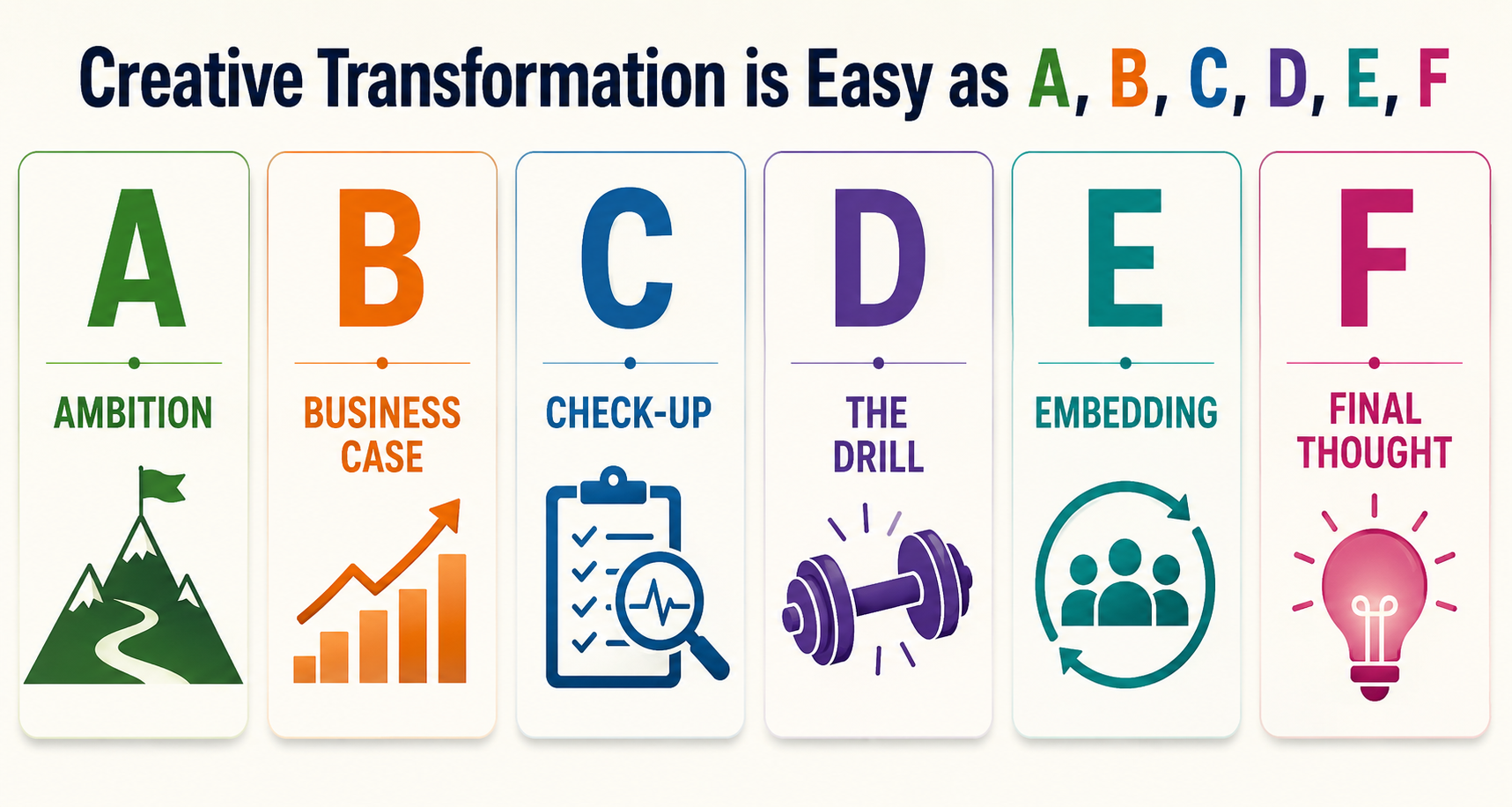
If you’ve seen work that cuts through the noise and drives growth and wondered: “How do we get that in our organisation?” - you’re not alone. The journey to a truly creative marketing organisation isn’t something tucked away in a mission deck. It’s a structured transformation with predictable building blocks.
During my time supporting creative transformation at global brands like Instacart, 7-Eleven and many others, I’ve seen what works and what doesn’t. So here’s my practical five-step approach - based on my experience with marketing organisations undergoing this shift plus drawing on one of the best proven cases out there, ABInBev - to help ensure a success journey on the way to producing great work that drives growth.
A is for AMBITION
Transformation starts with a clear, public ambition: what the change is, why it matters, and how creativity fuels it.
When Marcel Marcondes took on the global CMO role at AB InBev, he made exactly that link. The company pivoted from a finance-led, acquisition-first growth model to being marketing-led, with creativity as the engine of organic brand growth. The ambition wasn’t framed as a nice-to-have, it was tied to a clear outcome: to be recognised as a leading marketing-led organisation. The metric was to win Creative Marketer of the Year at the Cannes Lions Festival.
Being brave with a publicly stated ambition like this rallies the organisation and gives people something to anchor their decisions and behaviour around. Without a clear ambition your transformation is rudderless and likely to fail.
ABInBev went on to win CMOTY, twice in a row. Alongside that industry recognition, the business enjoyed several years of double-digit topline growth. That’s what a clear ambition can bring you!
B is for BUSINESS CASE
Ambition is inspiring, but leaders still want proof it moves the dial on business outcomes. A creative transformation changes how decisions are made:
- Where budgets go
- What success looks like (short-term metrics vs long-term brand building)
- What kinds of risk are acceptable
Understanding and communicating the business value of creativity is how you secure the support you need to change behaviours, processes and incentives.
For leadership, that can mean:
- Showing the link between creative recognition and brand growth (AB InBev found a strong relationship between award-winning work and commercial performance).
- Showing long-term share or revenue trends versus peers (McKinsey research)
- Highlighting the value of distinctive brand assets in creating mental availability and market share growth (Ehrenburg Bass research)
The business case anchors the transformation in outcomes the C-suite cares about and ensures support for a long term project helping shift the emphasis away from short term metrics that can slow or derail progress.
C is for CHECK-UP
Before you transform anything, diagnose the current situation, establish where you are.
Transformation shouldn’t be a leap into the dark, it starts with a baseline reality check that answers questions like:
- What type of work do we actually produce today?
- What are the gaps in skill, process, culture or mindset?
- Where are the roadblocks in planning, briefing, agency collaboration or company culture?
This “check-up” is key and sets a foundation for strategy. It gives you clarity on:
- What’s working (so you don’t accidentally break it)
- What’s missing (so you know what to build next)
Think of it like a medical check-up: you can’t prescribe a course of treatment until you know the diagnosis.
D is for the DRILL
Now, with a clear start point, you’re ready to make theory become practice.
The check-up tells you the gaps, the Drill is the ongoing work to close them. In organisations that have made this shift successfully, this looks like a structured Creative Excellence Programme built on three pillars:
- Capability building
Learning sessions, masterclasses and frameworks that build language and confidence around creative excellence. - Process change
Structures like Creative Councils, internal creative reviews or systematic brief critiquing ensure you don’t just talk about creative excellence you do it. - Reinforcement loops
Internal awards, shared case studies, “lessons learned” forums, tools that make learning stick.
AB InBev distilled this into their programme, CreativeX - a formal structure that includes training on how to ask for creativity, judge it and act on it. These are repeated, organisational, creative muscle-building drills.
E is for EMBEDDING
Change isn’t a sprint. Embedding new behaviours across an organisation is the long tail of transformational success.
Embedding happens when:
- Good work is not just made, it’s celebrated and rewarded
- Teams analyse competitors’ creative work and learn from it
- Creative thinking becomes part of regular planning, not a quarterly “activation”
- Internal incentives align with creative success
Organisations that generate consistently excellent work don’t rely on rare individuals, they build a shared creative language and capability that permeates the team.
This is exactly what newer industry frameworks, like the Creative Brand Lion introduced at Cannes Lions to recognise organisational creative capability (not just single campaigns) are spotlighting.
F is for FINAL THOUGHT
Creative transformation doesn’t happen by accident. It happens through ambition that inspires; a business case that convinces; a check-up that clarifies; drills that build muscle; and embedding that makes it normal.
If you want examples, frameworks, or case studies to bring this to life in your organisation drop us a line.
