

What actually wins at Cannes?
It's a question at the center of creative circles and internal business cases.
And luckily for you, we have the answers.
Back in June we shared a snap shot of last year’s Creativity Code - a data-driven methodology we've been developing with an AI strategy partner to predict what wins awards at Cannes and why. Using a predictive framework, developed from rigorous analysis, previous jury commentary and unique data points, it predicted 75% of the Titanium winners.
This year, over the Summer we put this methodology to work again, running it against every 2026 Grand Prix, Gold and Creative Effectiveness winners.
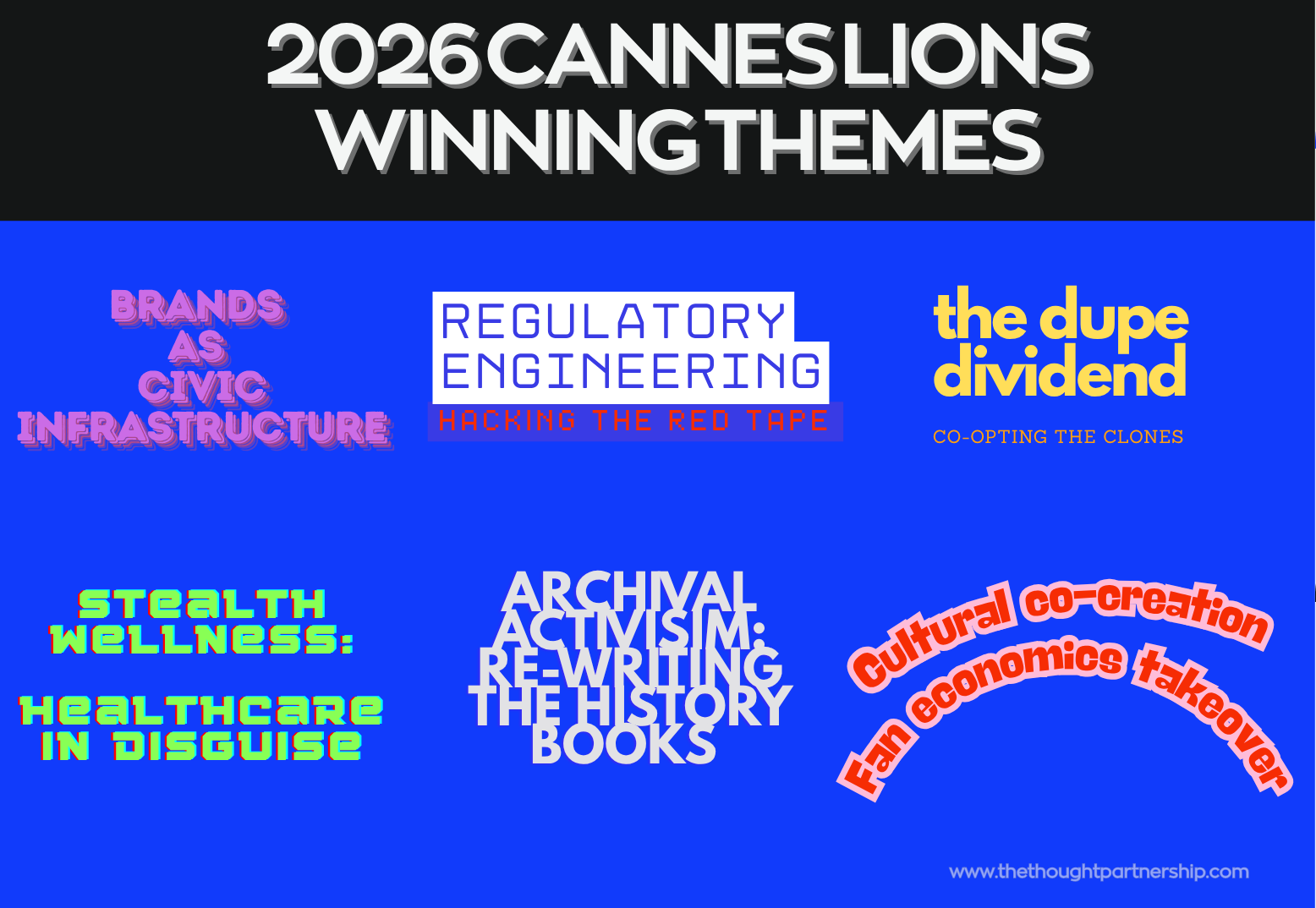
The result produced 6 common themes (read the results below), which rose to the top. What’s important is that this is not about “what wins awards” for the sake of winning awards, but work that is recognised and rewarded for creative excellence and impact. Love them or loathe them, creative award-show winners ARE a proxy for creative excellence.
Our analysis also drew some fairly fascinating insights as to what makes a perfect case film, how to craft a submission and why the best work touches all corners of an organisation.
This year, together with Creative Brief, our co-founder Charlotte Williams is also translating this research into a one-hour workshop - Cracking the Creativity Code - for brands and agencies.
More information right here!
Drop us an email if you'd like to hear how we can tailor our learnings, case studies and awards methodology for your sector or region.
Here’s a snapshot of what we found:
#1: Brands as Civic Infrastructure
Brands step in where governments and institutions have failed.
Example: Renault's "Utrecht Energized” deployed 500 Renault 5 E-Tech vehicles as a Vehicle-to-Grid fleet, effectively becoming the missing utility while physical grid expansion stalls.
#2: Regulatory Engineering: Hacking the Red Tape
Brands weaponise obsolete mandates and outdated legislation.
Example: IUCN French Committee x Fujifilm's "The Trojan Fax" exploited a legally-mandated but abandoned piece of government infrastructure, the long-forgotten fax machine, to bypass email filters entirely.
#3: The Dupe Dividend: Co-Opting the Clones
Brands showboat their primacy in the face of crisis and copycats.
Example: Clash Royale's "Copycats Welcome" co-opted counterfeit game clones to fuel its own player acquisition - even rewarding the fakes' players.
#4: Stealth Wellness: Healthcare in Disguise
Brands embed serious diagnostics inside everyday containers and touchpoints.
Example: Specsavers' "The Relationship Aid" disguised audiology as a romantic intervention for a 55+ demographic that spends heavily on intimacy products but avoids hearing aids.
#5: Archival Activism: Re-Writing the History Books
Brands rewrite electoral rolls and published testimonies.
Example: Whānau Ora's "The Māori Roll Call" hacked the national electoral roll itself, mobilising citizens via a public roll call to permanently switch onto the Māori roll.
#6: Cultural Co-Creation: Fan Economics Takeover
Brands make fans part of the work itself, as participants, creators, or the story's ending.
Example: Adidas' "Original Forever" made the brand part of how fans experienced Oasis's reunion tour, producing official tour merch for the first time in the brand's history across 41 dates.
